The Test Match That Rewrote Cricket History: India vs New Zealand, Wellington 2026
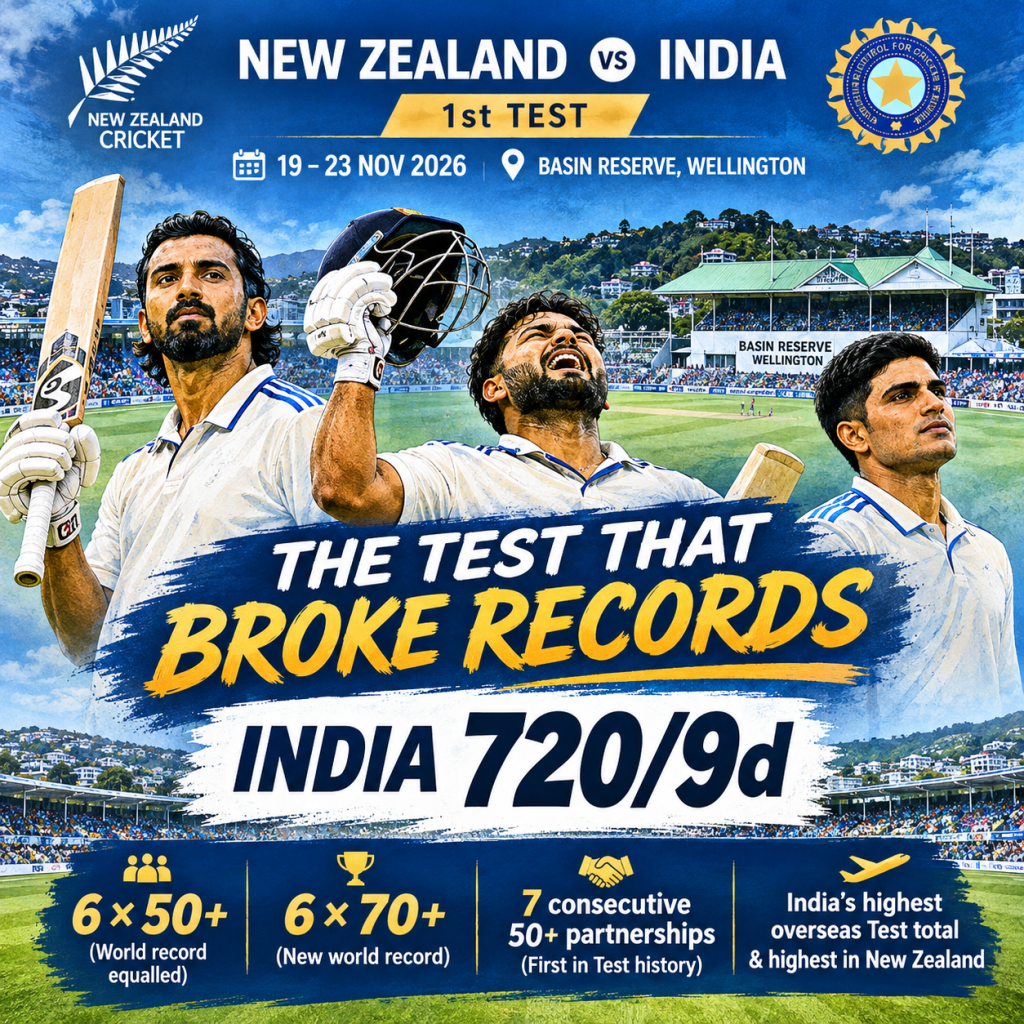
Six batsmen scoring 70 or more, seven consecutive fifty-plus partnerships, a 720-run innings and a remarkable collection of individual milestones. The first Test between India and New Zealand in November 2026 has given cricket statisticians plenty to talk about.
Cricket has been played at international level for nearly 150 years. Thousands of Test matches have taken place, countless centuries have been scored, and almost every imaginable batting achievement has been recorded somewhere in the game’s enormous statistical history.
Yet every once in a while, a match comes along that manages to produce something genuinely unprecedented.
The first Test between India and New Zealand at Wellington’s Basin Reserve, beginning on 19 November 2026, has been one of those matches.
What initially looked like a fairly conventional Test contest turned into an extraordinary exhibition of batting. India amassed 720 for nine declared, six batsmen passed 70, and the team established a world record for consecutive fifty-plus partnerships from the start of an innings.
There were individual achievements too. KL Rahul completed a rare overseas century collection, Rishabh Pant climbed the all-time six-hitting rankings, and New Zealand’s Glenn Phillips accomplished something no cricketer had previously managed against India.
As someone interested in cricket history and the extraordinary statistics the game produces, I found myself wondering just how many questions from this single match would deserve a place in a cricket trivia competition.
Quite a few, as it turns out.
720/9 Declared: India’s Greatest Overseas Test Innings
Let’s begin with the most obvious number: 720.
India’s mammoth first-innings total was not simply another 700-plus score. It established several important records simultaneously.
It became:
- India’s highest Test innings total outside India.
- The highest Test innings total ever recorded on New Zealand soil.
- The highest Test innings total against New Zealand, regardless of venue.
- The first 700-plus Test innings by a visiting team in New Zealand.
- India’s third-highest Test innings total anywhere in the world.
Before Wellington, India’s highest overseas Test score had been 707 against Sri Lanka in Colombo in 2010.
That record had stood for 16 years.
The previous highest Test total on New Zealand soil was 715/6 declared, scored by New Zealand against Bangladesh at Hamilton in 2019.
Meanwhile, the highest total against New Zealand had been West Indies’ 660/5 declared at Wellington in 1995.
India surpassed all three benchmarks in one innings.
India’s five highest Test innings totals
| Runs | Opposition | Venue | Year |
|---|---|---|---|
| 759/7 declared | England | Chennai | 2016 |
| 726/9 declared | Sri Lanka | Mumbai | 2009 |
| 720/9 declared | New Zealand | Wellington | 2026 |
| 707 | Sri Lanka | Colombo | 2010 |
| 705/7 declared | Australia | Sydney | 2004 |
Interestingly, India’s 720 was also their fifth Test innings of 700 or more. Only Sri Lanka, with seven such innings, had achieved the feat more frequently.
These are the kinds of statistics that make Test cricket fascinating. A team does not merely score a mountain of runs; it adds another chapter to a statistical history stretching across generations.
Six Batsmen Scoring 50 or More: A World Record Equalled
Perhaps the most remarkable aspect of India’s innings was how evenly the runs were distributed.
Ordinarily, when a team scores 700, you might expect one batsman to have made a double or triple century, supported by a couple of substantial contributions.
That was not the case here.
India’s highest individual score was KL Rahul’s 136.
Instead, six different batsmen scored half-centuries, with every one of them going on to score at least 70.
| Batsman | Runs |
|---|---|
| KL Rahul | 136 |
| Rishabh Pant | 128 |
| Shubman Gill | 98 |
| Yashasvi Jaiswal | 85 |
| Devdutt Padikkal | 80 |
| Dhruv Jurel | 78 |
This was the first time six Indian batsmen had scored 50 or more in the same Test innings.
It also equalled the world record previously achieved by Pakistan against New Zealand in Abu Dhabi in 2014.
Think about that for a moment.
In the entire history of Test cricket, only two innings had produced six individual scores of at least 50.
And both happened against New Zealand.
But there was an even more remarkable achievement hidden within those figures.
Six Batsmen Scoring 70 or More: A New World Record
While six half-centuries equalled an existing record, India went one better by having all six batsmen reach at least 70.
Never before had six players scored 70 or more in a single Test innings.
There had been 26 previous instances of five batsmen reaching 70, according to Wisden, but no team had managed six.
This distinction matters because reaching 50 is one thing. Having six separate batsmen continue to make substantial contributions is quite another.
Gill narrowly missed his century on 98, Jaiswal made 85, Padikkal scored 80 and Jurel contributed 78.
Not one of the six stopped in the fifties or sixties.
For cricket trivia enthusiasts, this is arguably a more interesting record than the 720-run total itself.
A question asking which team first had six batsmen score 70 or more in a Test innings would have a definitive answer: India, against New Zealand at Wellington in 2026.
Seven Consecutive Fifty-Plus Partnerships: A First in Test Cricket
Another extraordinary feature of India’s innings was its consistency.
Most enormous Test totals include at least one period when wickets fall quickly. Even when the top order dominates, the opposition usually manages to string together a couple of dismissals.
India refused to let that happen.
Their first seven wicket partnerships all exceeded 50 runs.
The partnerships were:
| Wicket | Partnership |
|---|---|
| First | 130 |
| Second | 165 |
| Third | 91 |
| Fourth | 100 |
| Fifth | 68 |
| Sixth | 75 |
| Seventh | 54 |
The remarkable part is not simply that India produced seven fifty-plus partnerships. Teams have previously recorded seven or more such stands within a Test innings.
What made Wellington unprecedented was that every partnership from the first wicket through the seventh reached at least 50.
No previous Test innings had begun with seven consecutive fifty-plus partnerships.
India themselves had recorded eight fifty-plus partnerships in an innings against England at The Oval in 2007, but those were not all consecutive from the start.
This distinction illustrates why cricket records sometimes need careful wording.
“Most fifty-plus partnerships” and “most consecutive fifty-plus partnerships from the start of an innings” are two different statistical achievements.
And Wellington now owns the latter record.
KL Rahul Completes His SENA Century Collection
KL Rahul’s 136 was an outstanding innings in its own right.
But it also completed an important career milestone.
Rahul became the first Indian opening batsman to score Test centuries in all four SENA countries:
- South Africa
- England
- New Zealand
- Australia
SENA is a commonly used abbreviation in cricket for these four countries, traditionally considered among the more demanding overseas environments for batsmen from the Indian subcontinent.
Conditions can vary enormously, of course. England offers swing, South Africa frequently provides pace and bounce, Australia presents its own challenges, and New Zealand can be difficult for visiting batsmen because of seam movement.
Scoring centuries in all four countries requires adaptability across different bowling attacks and playing conditions.
Rahul’s Wellington hundred completed that collection and made him only the second Asian opening batsman to achieve the feat.
It was a particularly satisfying milestone because it came during an innings in which he also provided the foundation for India’s enormous total.
Rishabh Pant: A Century, Six Sixes and Several Records
If Rahul supplied the foundation, Rishabh Pant provided much of the entertainment.
Pant scored 128 from 153 deliveries, hitting ten fours and six sixes.
His ninth Test century came in characteristic fashion: by hitting Glenn Phillips for six.
That was the fourth occasion on which Pant had completed a Test century with a six, equalling Brendon McCullum’s record.
But the innings carried several other statistical achievements.
Second-most sixes in Test history
Pant’s six maximums took his career total to 108.
That moved him past former New Zealand captain Brendon McCullum, who finished with 107, into second place on the all-time Test six-hitting list.
Only England’s Ben Stokes, with 138 at the time, remained ahead.
For a wicketkeeper-batsman, that is an extraordinary position to occupy.
Nine Test centuries as a wicketkeeper
Pant’s ninth Test hundred also placed him third on the list of designated wicketkeepers with the most Test centuries.
He stood behind:
- Adam Gilchrist — 17 centuries
- Andy Flower — 12 centuries
- Rishabh Pant — 9 centuries
Pant’s attacking approach can sometimes overshadow just how substantial his Test batting record has become.
Centuries in every SENA country
Pant also became the first Asian wicketkeeper to score Test centuries in all four SENA countries.
He joined Adam Gilchrist and Jonny Bairstow among wicketkeepers to have completed that geographical century collection.
His Wellington hundred was therefore much more than another entry in his personal century tally.
It strengthened his standing among the most accomplished wicketkeeper-batsmen in Test cricket.
Glenn Phillips Creates History Against India Across All Three Formats
It would be easy to focus exclusively on India’s batting records, but New Zealand had an important record-maker of their own.
Glenn Phillips scored 118 in New Zealand’s first innings.
That century completed a unique achievement against India in 2026.
Earlier in the year, Phillips had scored:
| Format | Score | Venue |
|---|---|---|
| ODI | 106 | Indore, January 2026 |
| T20 International | 107 | Auckland, October 2026 |
| Test | 118 | Wellington, November 2026 |
Phillips became the first cricketer to score centuries against India in all three international formats within the same calendar year.
Only one player had previously achieved the broader feat of centuries against the same opponent in all three formats during a single calendar year.
That was Rohit Sharma, against Sri Lanka in 2017.
Phillips therefore joined a remarkably exclusive club while becoming the first to accomplish it against India.
It is the sort of record that can easily disappear beneath headlines about a team’s massive innings, yet it deserves recognition in its own right.
The Less Obvious Records Hidden in the Scorecard
Some cricket records are obvious. Others require digging through scorecards, comparing historical statistics and paying attention to unusual details.
Wellington produced several of these less-publicised milestones.
India’s top five all scored at least 80
Rahul, Jaiswal, Padikkal, Gill and Pant all reached 80.
It was only the second time in Test history that a team’s first five batsmen had each scored at least 80 in the same innings.
Pakistan had previously achieved the feat against New Zealand in Abu Dhabi in 2014.
For India, it was also the first time their top five had all scored half-centuries in the same overseas Test innings.
India’s 14 sixes
India struck 14 sixes during their 720-run innings.
That was among their highest six-hitting totals in a Test innings, though not a world record.
Their own highest remained 18 against England at Rajkot in 2024.
It demonstrated how modern Test batting can combine the patience traditionally associated with the format with the aggressive strokeplay more commonly seen in limited-overs cricket.
Jacob Duffy’s expensive bowling figures
Not every record is one a player would particularly enjoy holding.
New Zealand bowler Jacob Duffy finished with figures of 1/201 from 33 overs.
That made it the second-most runs conceded by a New Zealand bowler in a Test innings, behind Stephen Boock’s 1/229 against Pakistan in Auckland in 1989.
Duffy also joined a particularly unusual statistical category: bowlers conceding more than 200 runs in at least 33 overs at an economy rate above six runs per over.
Pakistan’s Zahid Mahmood had previously done so against England at Rawalpindi in 2022.
Cricket’s record books have room for uncomfortable achievements as well as glorious ones.
Tom Latham’s pair
New Zealand captain Tom Latham was dismissed for a duck in both innings, suffering what cricketers call a pair.
Jasprit Bumrah dismissed him in the opening over of New Zealand’s second innings, adding to the pressure created by India’s enormous first-innings lead.
A pair is not necessarily a world record, but it remains a notable and rather unfortunate individual milestone in any Test match.
How Many of These Records Deserve a Place in Cricket Quiz?
While looking through the statistics from Wellington, I started thinking about how many of them could make interesting cricket trivia questions.
After all, cricket is one of the most statistics-rich sports in the world.
A single Test match can produce enough material for dozens of questions, ranging from relatively straightforward facts to records that even dedicated cricket followers might struggle to recall.
That is part of the appeal of Cricket Quiz, a cricket trivia platform where enthusiasts can test their knowledge of the game.
The Wellington Test alone offers an excellent collection of potential questions.
Consider these examples:
Question 1: Which team first recorded six individual scores of 70 or more in a single Test innings?
Answer: India, against New Zealand at Wellington in 2026.
Question 2: What is the highest Test innings total ever scored on New Zealand soil, as of November 2026?
Answer: India’s 720/9 declared at Wellington.
Question 3: Which two teams have recorded six individual half-centuries in a single Test innings?
Answer: Pakistan and India.
Question 4: Who became the first Indian opening batsman to score Test centuries in all four SENA countries?
Answer: KL Rahul.
Question 5: Which wicketkeeper overtook Brendon McCullum to reach second place on the all-time Test six-hitting list in November 2026?
Answer: Rishabh Pant.
Question 6: Which cricketer became the first to score Test, ODI and T20I centuries against India in the same calendar year?
Answer: Glenn Phillips.
Question 7: Which team became the first to record fifty-plus partnerships for each of the first seven wickets in a Test innings?
Answer: India.
Question 8: Which batsman equalled the record for completing four Test centuries with a six?
Answer: Rishabh Pant.
Question 9: Which country has recorded the most Test innings totals of 700 or more, as of November 2026?
Answer: Sri Lanka.
Question 10: Which Indian wicketkeeper became the first from Asia to score Test centuries in every SENA country?
Answer: Rishabh Pant.
And these are just ten questions from one match.
A proper cricket quiz can go much deeper, covering partnerships, individual milestones, historical comparisons, unusual dismissals and records that are rarely discussed outside cricket statistics circles.
That is what makes cricket trivia so enjoyable. Even someone who has followed the game for decades can encounter a statistic they have never heard before.
For anyone who enjoys testing their cricket knowledge, Cricket Quiz provides an opportunity to explore that side of the game.
Why Test Cricket Still Produces Extraordinary Stories
There is an interesting contradiction in modern cricket.
T20 cricket attracts enormous attention because of its speed, entertainment and spectacular hitting. Yet Test cricket continues to produce some of the game’s most extraordinary statistical achievements.
A Test innings lasting 166 overs offers opportunities that simply do not exist in shorter formats.
Batsmen can build long partnerships. Bowlers can experiment with different strategies. A team can recover from early difficulties or gradually wear down an opposition attack.
And occasionally, everything comes together in a way that has never happened before.
India’s 720 at Wellington was not built around one enormous individual innings. It was a collective effort in which six batsmen contributed substantial scores and seven successive partnerships passed fifty.
That is arguably what makes the achievement so unusual.
It was a record-breaking innings without a double century.
It was a display of extraordinary batting depth rather than one player’s dominance.
And it happened against a New Zealand side that had itself produced a respectable first-innings total of 368.
A Match That Will Be Remembered for Its Numbers
At stumps on the fourth day, New Zealand had reached 119/2 in their second innings and still trailed India by 233 runs.
The final result remained undecided, but the historical significance of India’s innings was already established.
Whatever happened on the fifth day, Wellington 2026 had delivered a remarkable collection of records:
- The highest Test innings total ever made in New Zealand.
- India’s highest overseas Test innings.
- Six half-centuries in one innings, equalling a world record.
- Six individual scores of 70 or more, setting a world record.
- Seven consecutive fifty-plus partnerships from the first wicket, another world first.
- KL Rahul completing his SENA century collection as an opener.
- Rishabh Pant becoming the second-highest six-hitter in Test history.
- Glenn Phillips completing centuries against India in all three international formats within one calendar year.
And that is before considering the smaller milestones and statistical curiosities scattered throughout the scorecard.
Cricket is sometimes described as a game of numbers. Matches like this explain why.
The numbers are not merely statistics. They represent achievements that connect today’s cricketers with generations of players who came before them.
Some records survive for decades. Others are broken within a few seasons. A handful may never be repeated.
Wellington 2026 has already secured its place in that history.
And it has certainly supplied enough material to keep cricket quiz enthusiasts busy for quite some time.
Statistics based on the India–New Zealand first Test at Wellington through the close of play on 22 November 2026. Match records and historical comparisons sourced from the ICC, Wisden and contemporary cricket reports.



Leave a Reply